The right way to judge this analysis is by how it will feel, fit, and hold up after the first month. Heat performance, electrical planning, materials, maintenance, and actual user habits matter more than showroom language.
My neighbor Greg, a retired firefighter in his late fifties, spent four months last year researching cold plunge tubs. He read every Reddit thread, watched dozens of YouTube walkthroughs, compared spec sheets from six manufacturers, and then installed his unit on a gravel pad that settled three inches by February. The tub tilted, the chiller line kinked, and the whole thing had to be lifted off with a dolly and reset on poured concrete. His unit was fine. His pad wasn’t. That story captures about 70% of the problems in this category.
A cold plunge tub is a real home project. Done well, it pays back in daily use for years. Done hastily, it’s a $5,000 headache sitting crooked in your backyard. The basics matter more than the brand name: footprint, pad, chiller sizing, electrical, and honest budgeting. Most home builds run between $2,490 and $16,980 depending on size, materials, and chiller class. Everything below is the long version, with specs, research, install realities, and costs.
Reading a Spec Sheet Without Getting Lost
This is where most buyers stumble. Spec sheets in the cold plunge category are dense, and a lot of the numbers only matter in context.
The typical residential unit is a single-user insulated tub (acrylic or stainless), 80 to 110 gallon capacity, with a 1/2 HP integrated chiller and ozone plus 5-micron filtration. Those are your baseline numbers. Here’s what actually deserves your attention:
Chiller HP vs. your climate. A 1/3 HP chiller can hold 50°F in a small insulated tub if you’re in Portland. It will struggle badly in a Phoenix garage in August. Match the chiller to your environment, not to the manufacturer’s best-case scenario. Undersized units run constantly and burn out components. Oversized units cycle hard and waste electricity. The manufacturer’s sizing chart is the starting point; your local climate is the correction factor.
Filtration and sanitation. Look for the micron rating on the filter (5-micron is standard), and whether the unit includes ozone, UV, or both. These systems are what let you go 6 to 12 weeks between full drains rather than dumping water every week.
Tub material. Insulated acrylic is the mainstream choice. Stainless steel is the commercial-grade option, heavier and more durable but significantly more expensive. Stock-tank conversions (the budget path) skip insulation entirely, which means you’re buying ice.
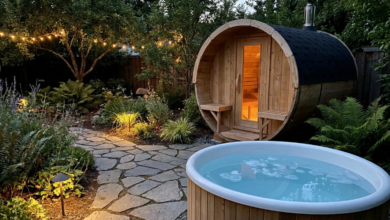
One thing I’d add: ignore the lifestyle photography on product pages. A tub that looks gorgeous on a flagstone patio surrounded by string lights tells you nothing about whether it’ll hold temperature or whether its chiller can be serviced. Read the spec sheet first.
See also: Wearable Technology: The Future of Fitness
What the Research Actually Shows
Cold water immersion research has moved fast in the last decade, and it’s worth separating what’s well supported from what’s still speculative.
Heinonen and Laukkanen reviewed cold-water immersion outcomes in 2018 (Frontiers in Physiology) and reported reductions in self-reported muscle soreness, modest improvements in mood, and measurable changes in catecholamine signaling after 2 to 5 minute immersions at 50°F to 59°F. The mood piece is what hooks most home users, honestly. The soreness reduction matters for athletes, but the “I feel sharper and calmer after” response is what keeps people coming back at 6 a.m. in January.
Allan and colleagues published a 2022 systematic review in the European Journal of Applied Physiology examining cold-water immersion after resistance training. They found recovery benefits, but with an important caveat: very frequent immersions immediately after lifting may blunt some hypertrophy signaling. The practical takeaway for home users is to keep cold sessions between 2 and 5 minutes and separate them from heavy resistance training by at least 4 hours when muscle growth is the primary goal.
The cardiovascular response is the part people underestimate. Cold exposure spikes heart rate and blood pressure within seconds. This is not theoretical. Adults with arrhythmias, uncontrolled hypertension, Raynaud’s phenomenon, or who are pregnant need to clear cold immersion with a physician before any home use. For healthy adults, the data is encouraging. But “encouraging for healthy adults” is doing real work in that sentence.
The Install: Pad, Power, and the Stuff Nobody Budgets For
Here’s the boring truth about cold plunge tub installation: the tub itself is usually the easy part. Factory-wired, delivered on a pallet, rolled into position. The site work is where projects go sideways.
The pad. A full tub of water on a steel chassis puts 800 to 1,200 pounds on a small footprint. That’s roughly the weight of a grand piano, concentrated on four feet or less of ground. A 4-inch compacted gravel pad with a drainage layer works for many backyard installs. A 4-inch reinforced concrete pad is the right call on soft soil or in freeze-thaw climates (which, if you’re above the Mason-Dixon line, means you). Greg’s gravel pad would have been fine in San Diego. In Connecticut, it was a mistake.
Electrical. Most modern residential cold plunge tubs run on a standard 110V outlet with a GFCI. Plug it into a properly grounded outlet on its own circuit. If your nearest outlet is more than 25 feet away or shares a circuit with a shop vac and a chest freezer, have a licensed electrician run a dedicated 20A 110V circuit. Some commercial-grade chillers are 240V and always require a licensed electrician. Don’t freelance 240V wiring. Just don’t.
Water care. Most home cold tubs combine ozone, UV, and a 5-micron filter cartridge. Test pH and sanitizer weekly. Replace cartridges every 6 to 12 weeks. Drain and refill on the manufacturer’s schedule. It’s roughly the maintenance load of a small hot tub, which is to say: not nothing, but manageable if you’re consistent.
What It Actually Costs, All In
The sticker price on a cold plunge tub is like the sticker price on a kitchen renovation: it’s the number that gets you in the door, not the number you’ll spend.
For cold plunge tubs specifically, a residential insulated unit with an integrated chiller runs $4,500 to $7,500. A commercial-grade stainless build with full filtration is $9,000 to $14,000. Stock-tank DIY setups come in at $400 to $900 but require manual ice, which is its own ongoing cost in time and money.
Now add the site work. A gravel pad runs $400 to $900. A concrete pad is $1,200 to $2,400. A 240V electrical run (if needed) adds $600 to $1,800. Permits vary by municipality but figure $100 to $300 if your local code requires them for outdoor electrical.
For context, if you’re also considering an outdoor sauna as part of a broader wellness setup, entry barrel kits start around $2,490, mid-tier cabins with quality heaters run $6,000 to $10,000, and premium thermo-aspen or panoramic glass builds hit $12,000 to $16,980.
Appraisers won’t add dollar-for-dollar value for a cold plunge tub, but well-built outdoor wellness setups are increasingly treated as selling features in Northeast and Pacific Northwest markets.
On the tax side: some home wellness equipment may be reimbursable through HSA or FSA accounts when a Letter of Medical Necessity is on file. Services like TrueMed issue LMNs after a clinician review for conditions where cold (or heat) therapy is a recognized treatment input. Eligibility is patient-specific, and the IRS rules are strict. Talk to your tax advisor before assuming your purchase qualifies. This analysis covers additional pricing tiers and model comparisons if you want to get granular before buying.
How It Stacks Up Against Alternatives
The cold plunge tub market has a comparison problem. The category sits between three cheaper alternatives (ice baths, stock-tank conversions, gym plunge memberships) and one more expensive one (commercial cold rooms or full cryotherapy chambers). Where you land depends on how lazy you want your daily routine to be.
A purpose-built insulated tub with a 1 HP chiller holds 39°F to 45°F all day with zero intervention. Walk out, lift the lid, get in. That convenience is the entire value proposition. A stock-tank DIY can hit those same temperatures with ice, but you’re buying and hauling bags, likely 40 to 60 pounds per session in summer. A chest-freezer conversion is cheap but lacks filtration, voids the warranty, and is mechanically marginal. It’s the pickup-truck-with-a-mattress of cold plunges: it works, but barely, and not for long.
The right answer is almost never the cheapest unit. But it’s also rarely the most expensive. It’s the build that matches your climate, your space, your electrical situation, and (this is the part people don’t want to hear) the routine you’ll actually maintain three months from now.
When to Call Someone Who Knows More Than You
Three moments in a cold plunge project where a professional earns their fee:
Pad work. Especially in freeze-thaw climates or on soft soil. A pad that settles after the unit is placed on it costs significantly more to fix than doing it right the first time. A contractor or experienced handyman saves you money here, not costs you money.
Electrical. Any 240V work. Any circuit you’re not confident about. A GFCI outlet is not optional, it’s a safety requirement around water.
Medical clearance. If you have an arrhythmia, uncontrolled hypertension, a recent cardiac event, Raynaud’s phenomenon, are pregnant, or are managing any chronic condition, a 10-minute conversation with your physician is the right first step. The research on cold exposure is promising for healthy adults. But “healthy adults” is the operative qualifier.
FAQs
Can I install a cold plunge tub on a deck?
Some smaller units can sit on a reinforced deck if the framing supports 600 to 1,200 pounds of loaded weight. Most full-size units belong on a ground-level pad. Confirm load capacity with a structural engineer or your contractor before placing anything on existing decking.
How often does a cold plunge tub need maintenance?
Replace filter cartridges every 6 to 12 weeks, run ozone or UV sanitation on schedule, test pH and sanitizer weekly, and drain and refill per the manufacturer’s interval. It’s roughly 10 minutes a week of active attention.
Will my electric bill spike?
A 1/2 HP cold plunge chiller in steady state pulls about 350 to 450 watts and typically adds $8 to $15 per month in most climates. If you’re also running a sauna, a 6 kW heater for three 20-minute sessions per week adds another $4 to $8 monthly at typical US residential rates.
Is a cold plunge tub safe during pregnancy?
Pregnant adults should not start a new cold plunge routine without explicit clearance from their OB-GYN. Core temperature changes carry real fetal risks, particularly in early pregnancy. This is a clear case where you defer entirely to your physician.
How loud is a cold plunge chiller?
Most residential chillers run at roughly 45 to 55 dB at one meter, comparable to a quiet conversation or a refrigerator hum. Place the unit where the chiller won’t bother neighbors or adjacent bedrooms, especially if you’re a pre-dawn user.
Disclaimer. This article is general consumer information, not medical advice. Heat and cold therapies carry real cardiovascular load. Anyone with arrhythmias, uncontrolled hypertension, Raynaud’s phenomenon, recent cardiac events, or who is pregnant should consult a physician before starting any new sauna or cold-plunge routine.
HSA and FSA reimbursement on wellness equipment is patient-specific and depends on a Letter of Medical Necessity from a clinician. Talk to your tax advisor before assuming a purchase qualifies.
For a practical next step, this analysis is a helpful reference.